

Alcohol, blood sugar and your heart. Harmful or helpful?
Is alcohol good or bad for prediabetes? What about alcohol and diabetes? And is what they say about red wine and the heart a good reason to open a bottle? Let’s dig in.
It’s happy hour!
Should you or shouldn’t you? You’re tapping your foot to the beat of the music when a friend orders a glass of cabernet. Another in your group asks for a mojito. You’d like a drink too, but you wonder: is it good for you or will it mess with your blood sugar?
Prediabetes and alcohol
Have you heard?
Drinking wine or other alcohol in small amounts – as little as 3 – 4 standard drinks per week – is linked to less risk of getting type 2 diabetes.

Photo credit: Sam Hojati
But is it worth the risks? Will a drink a day really keep the doctor away?
Some research suggests as little as one-half drink daily tamps down your risk for developing diabetes. So if you have prediabetes, you want to know what’s the best type of alcohol for your blood sugar. A recent study presented at a scientific conference took a stab at answering that question.
Researchers followed more than 300,000 regular drinkers from the United Kingdom for an average of 11 years. Here’s what they found:
- Drinking wine over beer or liquor was associated with lower risks of getting type 2 diabetes.
- Drinking with meals was associated with a 14% lower risk of diabetes compared to drinking without eating food.
- The benefit of drinking moderately occurred only among people who drank with meals.
- Heavy drinking was associated with a higher risk of developing type 2 diabetes.
Bottom line about prediabetes and alcohol: If you drink, wine with meals is probably your best option. High amounts of alcohol are associated with more diabetes (and lots of other health problems). If you drink, stick to moderate drinking. Jump to what is moderate drinking.
For more about what to eat with prediabetes, read the 7 best foods for your prediabetes diet.
Diabetes and alcohol
While drinking alcohol might have a few perks related to your heart or your blood sugar, alcohol with diabetes has plenty of risks.
If a side effect of your blood sugar-lowering medications is hypoglycemia (low blood sugar), alcohol can be perilous. Rule #1:
Never drink on an empty stomach.
Your liver – truly a super organ – regularly stores and then drops sugar into your blood to prevent levels from going too low. But your liver has to process alcohol too, so if it’s busy detoxifying a couple glasses of wine or the rum from your rum and Diet Coke, it can’t tend to your blood sugar level. The possible result: hypoglycemia, which is often severe and can occur many hours after drinking. Even if you go to bed with normal blood sugar levels, you can still experience dangerously low blood sugar levels in the middle of the night or even the following day.
The liver doesn’t multi-task and it prioritizes ridding your body of alcohol over stabilizing your blood sugar levels. Rule #2:
If you’re at risk for hypoglycemia, always carry glucose tablets or gel with you for quick treatment. A glucagon injection will not help you because while your liver is busy processing alcohol, it can’t respond to the additional glucagon.
Related: Which is more important – your heart or your blood sugar?
It might look like you’re drunk
Outwardly, hypoglycemia looks a lot like being drunk. If someone thinks you’re intoxicated when you’re really suffering low blood sugar, you probably won’t get the proper care you need.
You run the risk that people will think you’re intoxicated if they see you acting oddly. They may not consider that you have low blood glucose and need help quickly.

Grab the recipe for this super yummy Healthy Macaroni and Cheese
Heavy drinking is a definite NO
Diabetes, prediabetes or at any level of blood sugar, heavy drinking is always harmful. And especially so if your drugs can cause hypoglycemia such as insulin and sulfonylureas like glipizide and glyburide.
Bottom line about diabetes and alcohol: If you take drugs that might cause hypoglycemia, you’re at higher-than-usual risk of developing severely low blood sugar when you drink alcohol. Talk to a member of your healthcare team before picking up a glass. And follow these guidelines (or whatever guidelines your healthcare team advises):
- Always consume alcohol with carbohydrate-containing solid foods. Mixing vodka with cranberry juice won’t be sufficient because liquid carbs are processed too quickly. They won’t be there if you need them when your blood sugar drops too low in a couple hours or longer.
- Carry glucose tablets or gel with you.
- Never drink alone. Let your companions know you’re at risk for low blood sugar.
- Measure your blood sugar more often than usual. Test it an hour or two after drinking; before driving; at bedtime; in the middle of the night (especially if you’ve had more than a drink or two); and the next day.
If you’re not at risk for hypoglycemia or other health problems, a single drink with a meal is likely okay, but you should discuss this with your healthcare provider. If you have diabetic nerve damage, drinking can make it worse.
Alcohol and your heart
We’ve all heard that moderate drinking is good for the heart. I loved news that supported my love of red wine. But I’m rethinking my position on alcohol. I can’t justify opening a bottle of zinfandel or cab sav for health benefits. The evidence for better health isn’t strong enough, especially when I compare it to the risks.
While studies find an association between alcohol (red wine specifically) and lower risks of dying from heart disease, no study shows that drinking causes the benefit. Among the risks:
- high blood pressure
- high triglyceride levels
- greater risk of arrhythmias
- increased risk of heart failure when drinking in excess
Related: what to eat and drink with high blood pressure.
Alcohol and blood sugar:
Best options
Prediabetes and alcohol use can go together. Same for diabetes and alcohol. But you’ve got to take the warnings and recommendations above seriously. And since you and your health are different from anyone else’s, don’t forget to make your ultimate decision about drinking in conjunction with your healthcare team.
If you choose to drink, these are some of the better choices:
- Wine: red, white, rosé and sparkling
- Avoid sweet wines like Port, Moscato and ice wines because they have more sugar than drier wines
- Beer has about 15 grams of carbohydrate in 12-ounces. Light beer will have fewer carbs and calories
- Cocktails without fruit juice or added sugars in the way of soda or ice cream
- Some better options are rum and diet cola, gin and diet tonic water, and Bloody Mary
- Be cautious with canned cocktails. Some look like a single drink, but really have the alcohol of 2 or 2 1/2 standard drinks. Yes, I’ve seen a wine spritzer with the equivalent of more than 2 drinks in a 12-ounce can! In the next section, I’ll tell you how to know how much alcohol is in a packaged drink.
What is moderate drinking?
By definition, moderate drinking means having no more than one drink daily for women and no more than two drinks daily for men. But that giant pour of Spanish red blend – oh so delicious – I had recently at an outdoor cafe was more than a standard drink. So when I finished every last drop, I was over the recommended limit.
Large glasses of wine and cocktails with multiple shots count as more than a single drink.
| Alcoholic Beverage | Amount |
|---|---|
| Beer | 12 fluid ounces (1 average bottle or can) |
| Liquor such as bourbon and gin | 1.5 fluid ounces of 80-proof liquor 1 fluid ounce of 100-proof liquor |
| Wine | ~ 5 fluid ounces |
You need only two pieces of information and this online Standard Drink Calculator to figure out how many standard drinks are in a bottle, box, or can.
- Volume of the container in ounces or milliliters
- Alcohol by volume (%ABV or ‘proof’), which is listed on bottles, cans, and boxes – sometimes in teeny tiny letters
Plug these numbers into the calculator and you’ll see how many standard drinks are in your container. If you want a little more explanation, scroll below the calculator to watch a 3-minute video with my friend and colleague Kathleen.
What happens when you drink?
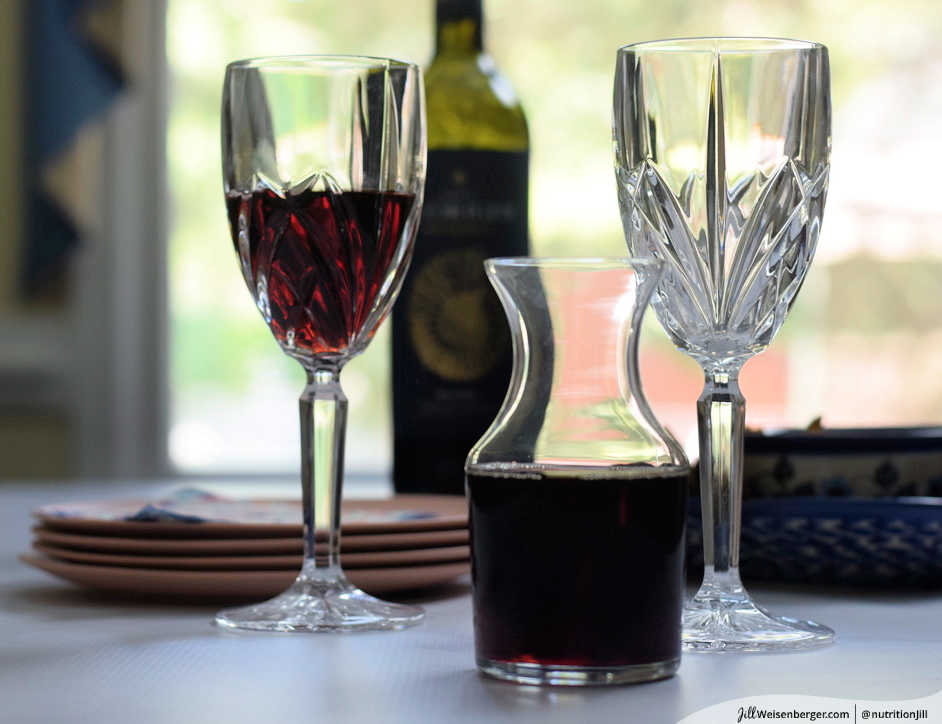
Pre-measuring my wine in a carafe helps me control my portion.
I can’t imagine giving up zinfandel, cab sav and other dry red wines any more than I can imagine giving up chocolate or cookies or chocolate cookies. But I do limit my intake.
Drinking adds calories.
Drinking lowers inhibitions, making it more likely I’ll make poor food choices.
Drinking raises my risk for lots of cancers.
Since I enjoy some wines so much, I have to be cautious of my intake. At home, I measure a single pour in a carafe, and in restaurants, I ask servers not to top off my glass.
Filed Under: Diabetes, Prediabetes

Jill Weisenberger
I'm Jill, and I believe simple changes in your mindset and health habits can bring life-changing rewards. And I don't believe in willpower. It's waaaay overrated. As a food-loving registered dietitian nutritionist, certified diabetes care and education specialist and certified health and wellness coach, I've helped thousands of people solve their food and nutrition problems. If you're looking for a better way to master this whole healthy eating/healthy living thing or if you're trying to prevent or manage diabetes or heart problems, you'll find plenty of resources right here.
Leave a Reply
3 Comments
Leave a Comment
Welcome to my Blog
Hi there! I'm Jill, a nutrition & diabetes expert and the author of 4 books.

I believe simple changes in health habits can bring you life-changing rewards.
And I believe willpower is way overrated.
Right here is where you can discover the mindset and habits to stick with healthy lifestyle choices most of the time - and drop the guilt when you don't.
Get the Second Edition!

Featured Posts



Thank you for sharing this informative article about diabetes. I hope there are a lot of practitioners who could read this and be guided accordingly.
Thank you for all the great information as usual. I always learn so much. Can you share what your favorite wines are? Thanks again!
I have many favorites, but my tastes go to full-bodied, dry and lots of tannins. I typically choose Malbec, Cab Sav, or Zinfandel – not because they’re more healthful but because I like them.