
Will the glycemic index help you make smart food choices?
Inside: Will the glycemic index help you lose weight and control your blood sugar? Perhaps a tiny bit. Learn the pros, cons, and best tips for using the glycemic index.
“Don’t eat potatoes. Stay away from root vegetables like rutabagas. And skip watermelon and Cheerios too.”
If you’ve been denying yourself these and other delicious, health-boosting foods because you’ve heard they’re high on the glycemic index (GI), read on. You’ll get clear on whether using the glycemic index to pick your food choices is worth the time and effort.
What is the glycemic index?
The GI ranks carbohydrate-containing foods from 0 to 100, indicating how a single food in a portion containing 50 grams of digestible carbohydrates is expected to affect your blood sugar. The greater the number, the greater the expected effect.
If you’re interested, you can find the GI of various foods on the University of Sydney website, or in an easy-to-read chart here.
- High GI foods: > 70 (such as watermelon, white rice, and boiled potatoes)
- Low GI foods: < 55 (such as barley, apples, strawberry jam, and ice cream)
Do you see what I see? When I look at the examples above, I’m frustrated that sugary jam and ice cream appear to be better choices than nutrient-rich watermelon and potatoes!
Let’s take a closer look.
Will the glycemic index help you lose weight?
Probably not.
Though there are reasonable theories about why low GI diets would lead to greater weight loss than high GI diets, when scientists look at the totality of the current research, there just isn’t strong evidence. In a 2021 paper in Advances in Nutrition, researchers looked at dozens of studies (both observational and interventional) totaling nearly 2 million people.
They report that low GI diets were no better than high GI diets for losing weight. In fact, some population studies found that people eating a high GI diet actually had a lower BMI. When I put both observations together, I don’t see much role for the GI in weight loss – especially since using the GI is complicated. More on that in a bit.
Does using the GI lower your blood sugar?
Perhaps a tiny bit.
Your blood sugar varies more with the amount of carbohydrates you eat than it does with the source of carbohydrates. In other words, if you eat 45 grams of carbohydrates from ice cream, you’ll likely see a bigger blood sugar rise than if you ate only 15 grams of carbohydrates from milk, candy, bread, ice cream, or anything else.
The amount of carbohydrate is typically more important than the source.
Some studies of people with diabetes show no benefit to using the GI, but others show modest reductions in A1C, which indicates your average blood sugar levels over the last 3 months. Two systematic reviews showed reductions of 0.15% and 0.5%. This is like dropping from 7.5% to 7.35% or to 7.0%.
These are small changes, but they are not meaningless.
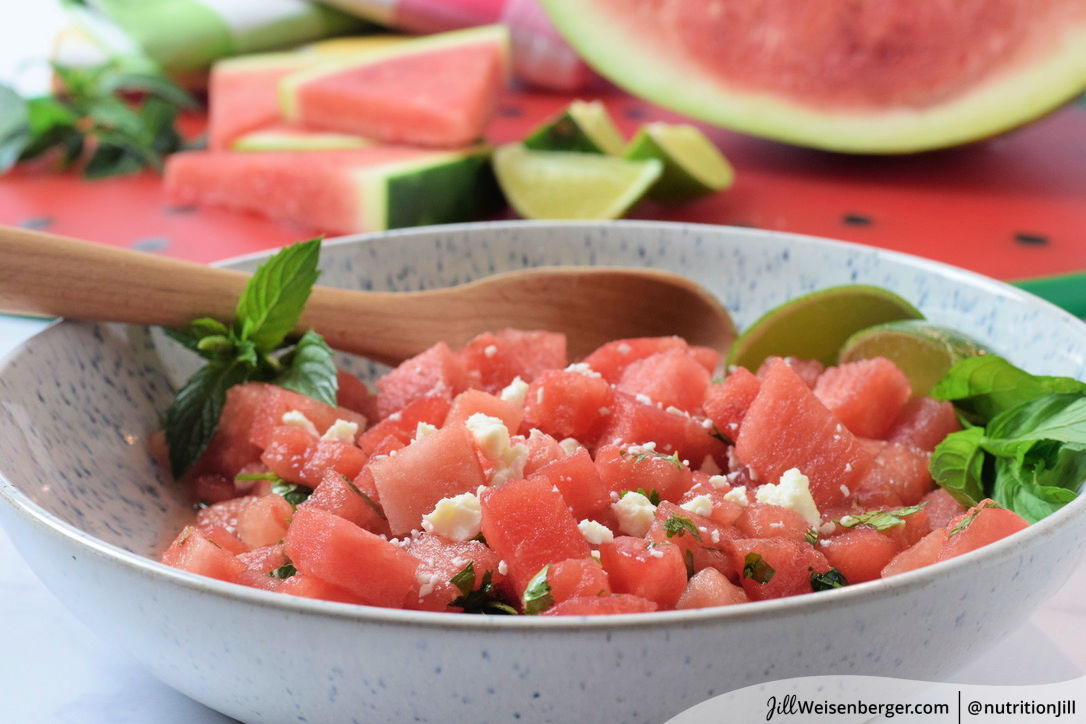
By itself, watermelon has a high GI, but once you add feta cheese and other ingredients to make a salad, the blood sugar effect is less clear.
If you already have a good diet and monitor your total carbohydrate intake (yes, monitor your carb intake, don’t give up carbs), using the GI in combination with other meal-planning techniques – like carb counting or the plate method – might modestly lower your A1C.
Is the GI worth the effort?
A student in my first session of Prediabetes Turnaround noticed I never discussed the glycemic index in class or in the videos. He wondered if that was because I thought it was useless. Not entirely useless because it might help some people fine-tune their carb choices for blood sugar management, but I think it’s rarely worth the effort.
5 ways the glycemic index can steer your wrong
#1 You can run into nutritional trouble
As you saw above, jam and ice cream score more favorable GI numbers than plenty of nutritious foods. I’d rather you eat grapes and whole-wheat bread for their disease-fighting prowess than Snicker’s bars and corn chips, which are lower on the GI ranking.
#2 The GI doesn’t consider your portion size
Recall that the GI is based on a serving size that contains 50 grams of digestible carbohydrates, so the GI of a small piece of cake is the same as the GI of a large piece of cake. But the large piece will spike your blood sugar much more.

Nope, I did NOT eat the entire cake. Two small slices are enough on my birthday!
Plus, we rarely eat food in portions containing exactly 50 grams of carbohydrates. For example, few people eat 1½ pounds of carrots or 9 cups of cherry tomatoes in a single sitting.
#3 The GI doesn’t consider that you eat more than 1 food at a time
The glycemic response (how your blood sugar changes) depends on what else you’re eating. When researchers used the GI of the individual foods in a meal weighted according to the amount of carbohydrate each food contributed, they found they overestimated the GI of the meal. In one example, the measured GI of a meal with potatoes, carrots, peas, and chicken was 22% lower than the predicted GI.
Basically, this means that when you add other nutrients like protein, fat, and fiber, you change the way a carb-rich food affects your blood sugar by itself. If you want to eat white bread, you can get a lower GI by buttering it. But is that smart to load up on high-calorie, high-saturated fat butter simply for a smaller blood sugar rise?
#4 How ripe is your fruit?
The GI even varies according to the ripeness of your fruit. An under-ripe banana, for instance, has a lower GI than a ripe banana, which has a lower GI than an over-ripe banana.
#5 Your cooking methods affect the GI
Al dente spaghetti is lower on the GI scale than well-cooked spaghetti. And cold potatoes score better than hot potatoes. If you add vinegar to your food, you lower the GI too.

Cold potatoes and vinegar dressing lower the blood sugar effect compared to hot, boiled potatoes. You’ll say yum to this healthy potato salad.
The best way to use the GI
You can see how complicated the glycemic index is. If you choose to use it, consider these 2 things:
#1: Combine the GI with your healthy eating habits. Just because a candy bar has a lower GI than grapes, doesn’t make a Snickers bar a health food.
#2: Make choices between similar foods. For example, a baked potato with skin has a lower score than a baked potato without skin, and sourdough bread has a lower score than regular white bread. Al dente pasta is lower than well-cooked spaghetti, and an orange is lower than orange juice.
While the GI might have some merit, I worry it might distract some people from more important healthy eating strategies like reading food labels, meal planning, eating mindfully, lowering added sugars, and more.
Filed Under: Diabetes, Prediabetes, Weight Loss
Tagged: blood sugar, carbohydrate, glycemic index

Jill Weisenberger
I'm Jill, and I believe simple changes in your mindset and health habits can bring life-changing rewards. And I don't believe in willpower. It's waaaay overrated. As a food-loving registered dietitian nutritionist, certified diabetes care and education specialist and certified health and wellness coach, I've helped thousands of people solve their food and nutrition problems. If you're looking for a better way to master this whole healthy eating/healthy living thing or if you're trying to prevent or manage diabetes or heart problems, you'll find plenty of resources right here.
Leave a Reply
Welcome to my Blog
Hi there! I'm Jill, a nutrition & diabetes expert and the author of 4 books.

I believe simple changes in health habits can bring you life-changing rewards.
And I believe willpower is way overrated.
Right here is where you can discover the mindset and habits to stick with healthy lifestyle choices most of the time - and drop the guilt when you don't.
Get the Second Edition!

Featured Posts